How to Improve Local SEO for Roofing Contractors
How to Improve Local SEO for Roofing Contractors
Why Most Roofing Contractors Don't Show Up on Google
Your trucks are good. Your crews are solid. But when a homeowner in your city types "roofer near me" into Google, your company isn't in the results. The guy who shows up — you've seen his work. He's not better than you. He just got found first.
That gap isn't about your reputation. It's about visibility. And visibility is a problem you can fix.
Most roofing contractors either have no online presence worth mentioning, or they paid an SEO agency that treated them the same way they'd treat a dentist or a law firm. Generic SEO doesn't work for roofing. Your customers aren't browsing nationally — they're searching in your city, your neighborhood, your zip code. The strategy has to match that intent exactly.
There's a three-phase system that fixes this. It doesn't require a big budget. It doesn't require you to become a marketer. It requires the right structure, built in the right order.
What Local SEO Actually Means for Roofers
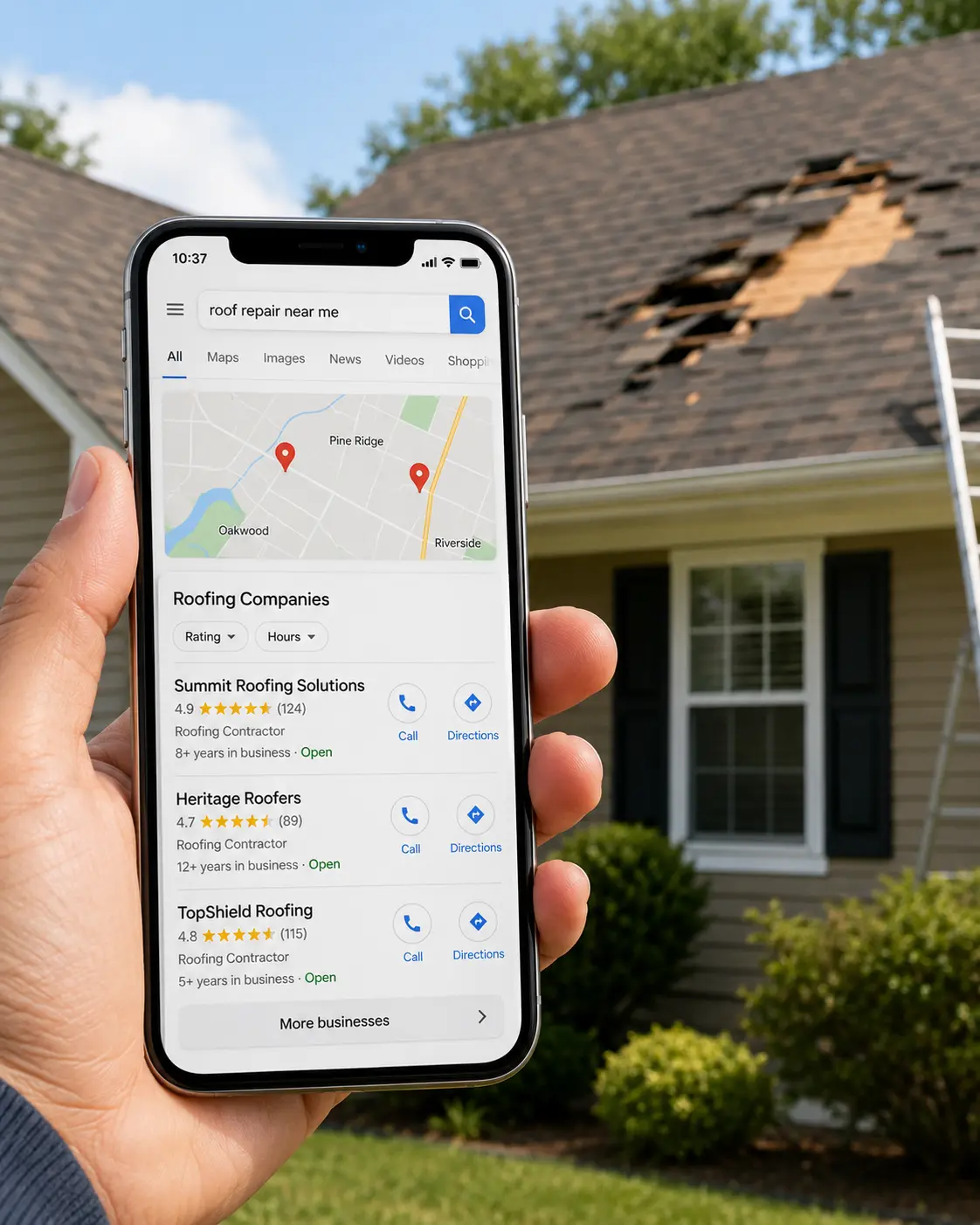
Local SEO for roofing contractors is not the same as general SEO. The goal isn't to rank everywhere — it's to show up in the Google Map Pack for searches happening in your service area.
The Map Pack is the block of three businesses that appears at the top of Google results when someone searches "roof repair [city]" or "roofing contractor near me." Studies consistently show that positions 1 through 3 in the Map Pack capture more than 60% of all clicks. Position 4 is already a different page. If you're not in the top three, you're largely invisible.
Ranking in the Map Pack comes down to three signals Google weighs heavily: relevance (does your business match what the person searched?), proximity (are you located near the searcher?), and prominence (does Google trust that you're a real, established business?). Your job is to give Google clear signals on all three.
That starts with your Google Business Profile.
Your Google Business Profile (GBP) is the single most important local SEO asset you have. It controls how your business appears in Google Maps, the Map Pack, and the local section of search results. Most roofers have one. Most of them are incomplete.
Here's what a fully optimized GBP looks like:
Categories: Your primary category should be "Roofing Contractor." Add secondary categories for every service you offer — gutters, siding, storm damage repair. Google uses these categories to decide which searches your profile is relevant for.
Services: List every specific service with a name and description. Don't just say "roofing." Say "Asphalt Shingle Roof Replacement," "Emergency Roof Tarping," "Storm Damage Roof Inspection." Be specific. Google reads those entries.
Business Description: Write 750 characters that describe what you do, where you work, and what makes you the right call. Include your city and nearby service areas naturally.
Photos: Upload at least 10 photos of real jobs in your area. Geo-tag them with your location before uploading. Google treats geo-tagged photos as a local relevance signal.
Q&A Section: Post your own questions and answer them before customers do. Price ranges, storm damage claims, and how long a replacement takes are all fair game.
One critical point most agencies miss: your GBP must match your website. The name, address, phone number, and service descriptions need to be consistent between your profile and your site. A disconnect there is the most common reason roofing companies don't rank locally.
One homepage is not a local SEO strategy. Google needs to see dedicated pages for every service you offer, each one targeting a specific service-and-city combination.
Think about it this way: if a homeowner in Lacey, Washington searches "emergency roof repair Lacey," Google is looking for a page that specifically covers emergency roof repair in Lacey. Your homepage about roofing in general doesn't answer that search. A dedicated page built around that exact combination does.
This is what we call the Core 30 model — building one page for every major service across every city in your service area. Roof repair in your home city. Roof replacement in your home city. Then the same pages targeting each nearby city. Over time, that creates a full map of your service area that Google can index, understand, and rank.
Each service page should include:
The service + city in the title tag, H1, and naturally throughout the body
A description of how that service applies in that area — local weather, common damage types, permit requirements
Your license number, years in business, and a real local phone number
Internal links connecting to related service pages and your homepage
This structure is what lets Google build a complete picture of your roofing business — what you do, where you do it, and who you are. Most contractors have never given Google that picture. That's exactly why they don't rank.
Prove Your Expertise with Content and Geographic Expansion
Once your core service pages are built and your GBP is dialed in, Phase 2 is about topical authority. Google rewards roofing companies that answer the questions homeowners are actually searching.
What does a roof replacement cost in this area? How long does a storm damage insurance claim take? How do you know whether you need a repair or a full replacement? These are real questions. Blog posts and FAQ pages built around them do two things: they give Google more reason to trust you as a local authority, and they give homeowners a reason to trust you before they ever call.
Pull your topic ideas directly from Google's "People Also Ask" box. Whatever questions appear there for your target keywords are the exact questions your future customers are typing. Answer them clearly and completely.
Phase 3 is geographic expansion. Once your home city is ranking, you build outward — creating pages that target nearby cities, neighborhoods, and zip codes. Include local details that make each page credible: weather patterns, common storm damage types in that area, HOA considerations. Your visibility grows like a web spreading from your home base, pushing into more territory without starting over each time.
Real Results: How United Roofing Solutions Grew Traffic 617% in 6 Months
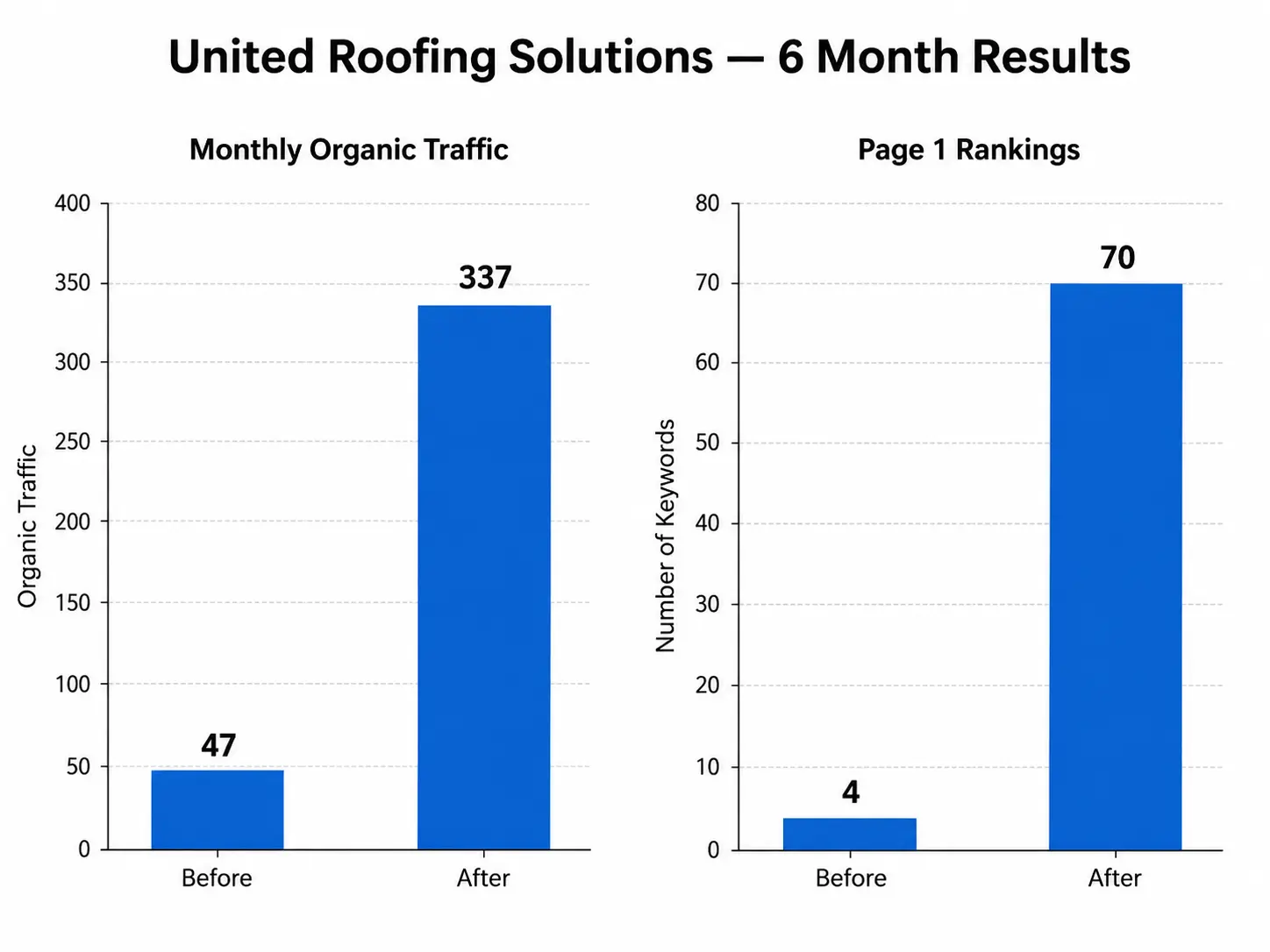
United Roofing Solutions in Olympia, Washington started working with Power 360 Media in November 2025. At that point, their website was pulling 47 monthly organic visitors. They had 4 Page 1 rankings and zero top-three positions. Their monthly traffic value — what those rankings would cost in paid ads — was about $450.
Six months later, those numbers don't look anything like that.
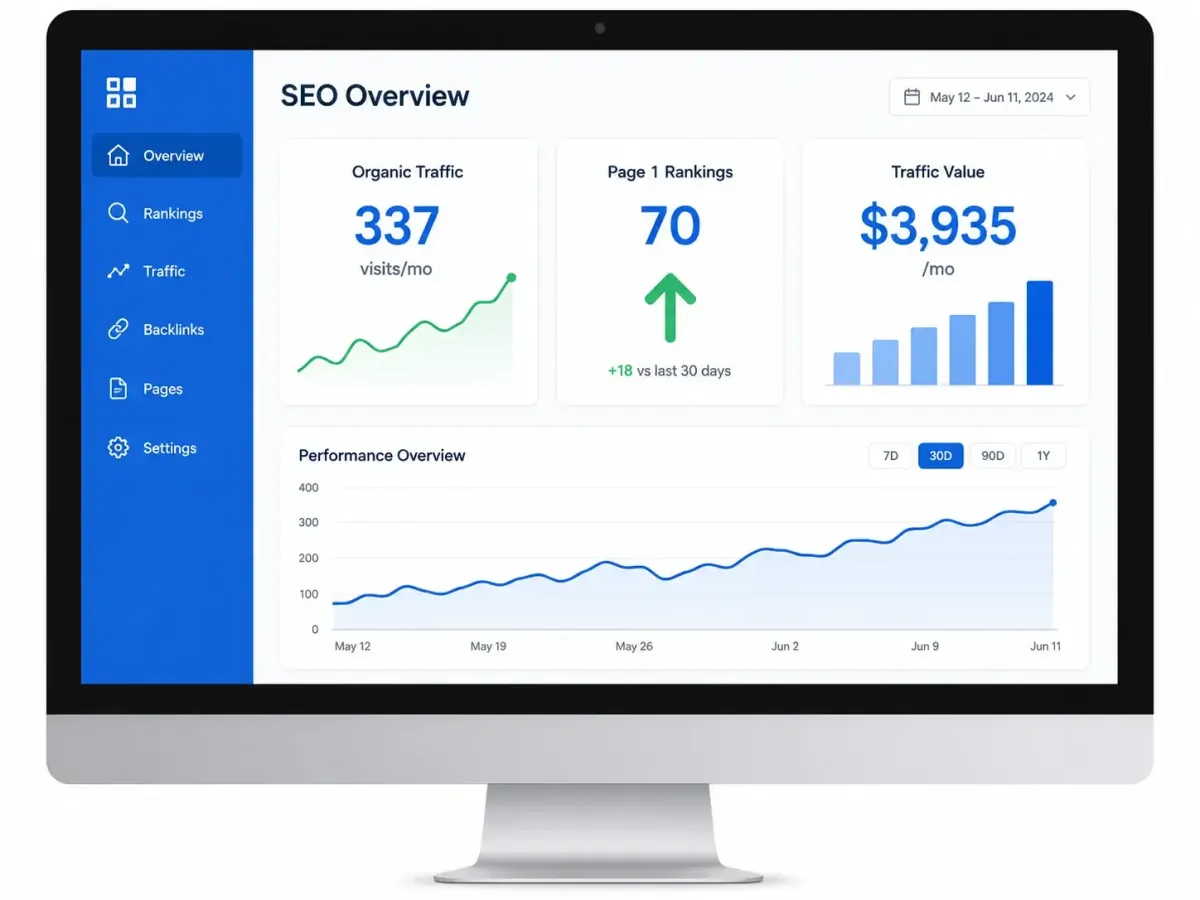
By May 2026, United Roofing had 337 monthly organic visitors. Their keyword footprint grew from 98 tracked keywords to 648. Page 1 rankings went from 4 to 70 — a 1,650% increase. Top-three rankings went from zero to 12. Monthly traffic value hit $3,935 per month, an 8.7x return on the traffic value investment.
They rank #1 for "Roofing Olympia WA," "Roofing Company Olympia," "Roofer Olympia," and "Roofing Services Olympia WA." They also hold the top organic position for University Place, expanding their reach without starting over.
That growth came from the same three-phase system described in this post. Technical foundation first. Targeted service pages and content second. Geographic expansion third. Data verified via Search Atlas Site Explorer and Google Search Console, May 2026.
How to Know Your Roofing SEO Is Working
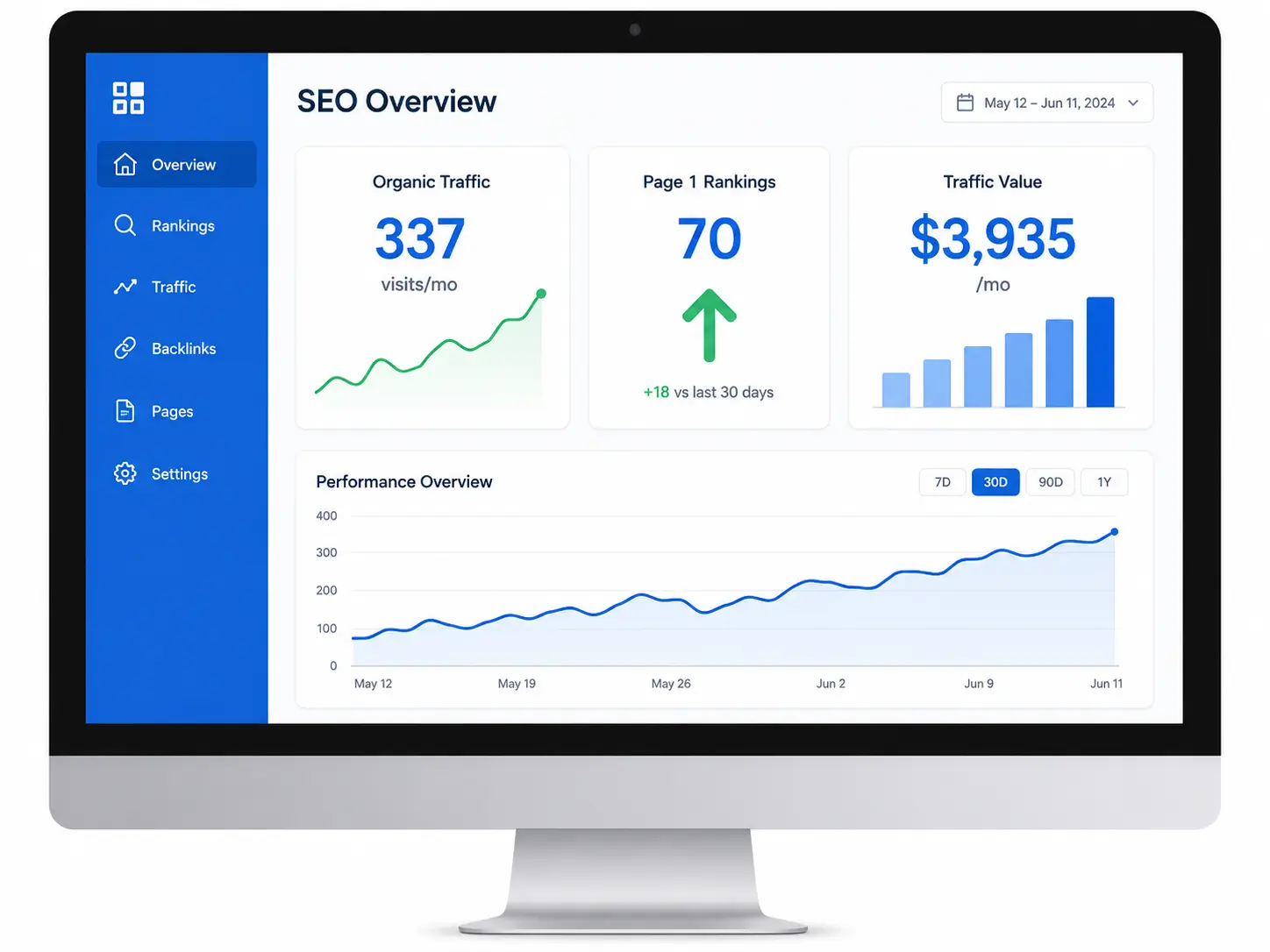
A lot of roofing contractors have paid for SEO and had no idea whether it was working. That's not acceptable. You should be tracking three things every month.
Organic Traffic: Use Google Search Console (it's free) to see how many people are clicking through to your site from Google search. A healthy roofing SEO campaign shows steady growth in organic clicks quarter over quarter.
Keyword Rankings: Track your most important service + city keyword combinations. Tools like Search Atlas show you exactly where you rank for each term and whether that ranking is moving up or down.
Traffic Value: This is the estimated monthly cost if you had to pay for your current organic traffic through Google Ads. It's one of the clearest indicators of SEO momentum. United Roofing's traffic value grew from $450 to $3,935 per month — that's the actual financial value of improved rankings.
GBP Insights: Inside your Google Business Profile dashboard, you can see how many people viewed your profile, clicked your phone number, or asked for directions. Rising GBP engagement is a strong signal that your local presence is working.
If your agency can't show you these numbers in plain language every month, that's a problem worth addressing.
Frequently Asked Questions
What is local SEO for roofing contractors?
Local SEO for roofing contractors is the process of optimizing your online presence so your business shows up in Google search results when homeowners in your area search for roofing services. This includes your Google Business Profile, your website's service pages, and the local signals that tell Google you're the right company for that search in that city.
How long does roofing SEO take to show results?
It depends on your starting point and your market, but a well-executed system can produce real movement within 90 days. Power 360 Media's client United Roofing Solutions went from 47 monthly organic visitors to 337 in six months — with Page 1 rankings growing from 4 to 70. That's a real timeline from a real roofing company in a competitive local market.
Do I need a new website to improve my roofing SEO?
Not always. Some roofing websites can be optimized with new service pages and better structure. Others have technical problems that make ranking very difficult no matter what else is done. Power 360 Media runs a free audit on every potential client's site before recommending anything. You see exactly what's broken before spending a dollar.
What is the Google Map Pack and why does it matter?
The Map Pack is the block of three local businesses that appears at the top of Google when someone searches a local service query like "roof repair near me." Positions 1–3 in the Map Pack capture the majority of clicks for those searches. If you're not in those three spots, most of the people searching for a roofer in your city never see your business.
How does my Google Business Profile affect my rankings?
Your GBP is Google's primary source of information about your local business. An incomplete, inconsistent, or unclaimed profile sends weak signals to Google — which means lower rankings. A fully optimized profile with accurate categories, detailed services, geo-tagged photos, and regular activity sends strong relevance and prominence signals that move you up in both the Map Pack and organic results.
What are service pages and how many do I need?
Service pages are individual pages on your website targeting a specific service in a specific city — like "Roof Replacement Olympia WA" or "Emergency Roof Repair Lacey WA." You need one page for every major service in every city in your service area. For most roofing contractors, that means building 20–50 pages to cover their market. This is the Core 30 model Power 360 Media uses with every roofing client.
How is roofing SEO different from regular SEO?
Roofing is a local business. You're competing with two or three other contractors in your city for a handful of search positions — not with roofing companies across the country. Roofing SEO focuses on the Google Map Pack, service-plus-city page structure, GBP alignment, and local E-E-A-T signals like your contractor license, years in business, and local service area. General SEO agencies rarely build for these signals, which is why so many roofers have paid for SEO that never moved their local rankings.
Ready to Rank? Get Your Free Roofing SEO Audit
Power 360 Media — Olympia, WA | (360) 523-1717 | power360media.com
Free audit: freegbpaudit.com | Month-to-month. No contracts. No locked-in periods.